
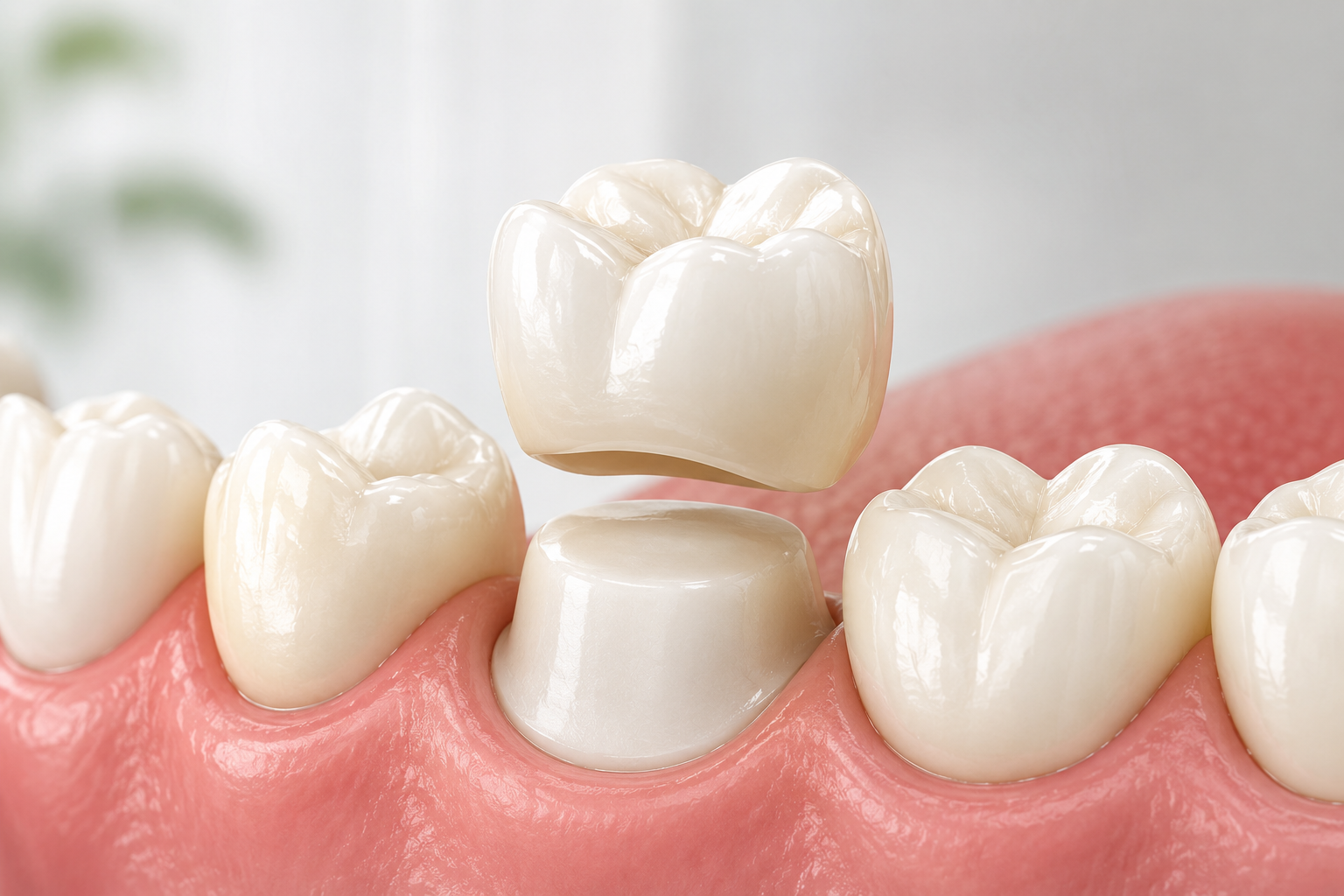
Dental crowns are laboratory custom-made caps that are prepared by a dental technician to sit as a cap on your tooth. The primary function of these custom-made caps is to restore tooth strength, shape and functionality.
Dental crowns are generally prescribed for protective and restorative reasons to serve as a protective layer. Dentists advise placing a dental crown when patients have advanced tooth decay, fractured or cracked teeth, large fillings or severe enamel wear; they are always recommended after a root canal procedure.
In restorative and cosmetic dentistry, dental crowns can also serve purpose by anchoring dental bridges or bridging dental implants to replace missing teeth, restoring function and giving a natural aesthetically pleasing finish to your smile. Dental crowns can also be used for strictly cosmetic enhancements, they are able to cover the tooth surface to cover any tooth discolouration and shape irregularities.
Installing a dental crown for restorative dentistry in the UK can be done through the NHS or private means. However, dental crowns used for any aesthetic purposes are only available through private dentistry.
Why Do Dentists Recommend Dental Crowns?
There has always been an ongoing debate on whether crowns or fillings should be prescribed for dental complications listed above. And most of the time, dental crowns have had the upper hand.
Irrespective of whether the crown placements is through NHS or privately paid, dentists usually advise them for different reasons.
Protecting the Tooth: A tooth which has suffered decay is structurally weak. The decay can spread to surrounding teeth and penetrate deep into the dental tissue rendering functionality obsolete. Even if your tooth is cracked or has a cavity, the structure is weak. Crowns installed through NHS or private services serve as protective shields reducing the risk of breakage.
Reinforcement after Root Canal: If you have recently undergone a root canal, it means that the infected pulp with your tooth has been removed. This procedure alone leaves the tooth brittle. The molars and premolars that absorb significant chewing force are left with no protection and are prone to fracture or breakage. Placing a dental crown acts as a reinforcing agent for the tooth and prevents them from breaking due to impact from the chewing force.
Long-term Stability: If your tooth has suffered a significant loss of its natural structure due to cavity, decay or breakage, then it undoubtedly loses stability. A dental crown’s custom-built nature serves as a covering that protects the entire tooth by encasing and reinforcing weakened teeth, holding the remaining tooth structure together and reducing the risk of tooth fracturing.
Restoring Breakage and Wear: If you have a chipped or broken tooth, it’s not only the aesthetics that suffer a blow. It is important to determine how well that tooth can sustain the impact of your chewing force. Similarly, if your tooth has worn out due to constant grinding, it loses the enamel. Dental crowns protect the tooth from further deterioration, give it strength and rebuild its structure.
Oradent Dental Clinics across the UK employ modern dental practices for installing dental crowns through NHS or privately paid schemes for ensuring strong oral health.
What Is The Difference Between A NHS Crown And A Private Crown?
The primary difference between an NHS crown and private crown is the materials used and pricing structure used for installation.
An NHS crown falls under the Band 3 of NHS dental treatment and costs the patient approximately £332.10 (As of April, 2026). The cost paid by the patient is the charge for the entire treatment which includes one or more dental crowns, this also includes the respective Band 1 and Band 2 charges.
A private crown, as the name suggests, is paid entirely by the patient hence the cost is higher. It costs between £650 and £1,500 per tooth, although prices can fluctuate based on dentist location and experience.
Another major difference between NHS and private dental crowns is the flexibility to choose. NHS crowns leave no space for you to choose the materials of the crown and are mainly used for restoring function. Private crowns give you a broader range of material and customisable options that restore functionality and aesthetics.
Is A Private Crown Better Than The NHS?
The answer to whether a private crown is better than a NHS crown lies in your specific dental goals. However, a stark comparison between the two can help you make the call.
| Factors | Private Crown | NHS Crown |
| Price | Between £6500 to £1,500 | £332.10 (Flat price) |
| Material | Porcelain and Ceramic crowns such as Emax and Zirconia, Gold alloy | Metal, Porcelain fused to metal |
| Subsidy | No Subsidy | The UK government pays the remaining cost |
| Appearance | Greater emphasis on cosmetics and customisation | Functional and aesthetic where clinically necessary |
| Treatment Duration | Often more flexible scheduling | Depends on NHS availability |
Oradent Dental Clinics offer both private and NHS crown installation options. Choose the one that suits you and fix your dental health appointment today.